
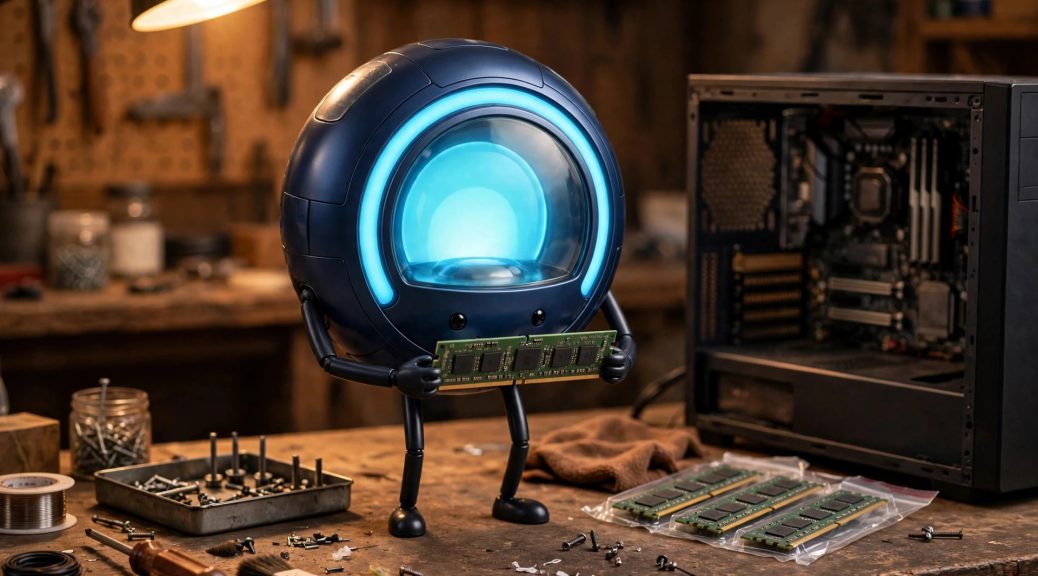
If you’ve priced a RAM upgrade lately, you already know something is badly wrong. A standard 32GB DDR5 kit — the sweet-spot capacity for a gaming PC or a homelab box — cost roughly $95 before the shortage. As of November 3, the cheapest tracked listing for a 2x16GB DDR5-6000 kit was $429, and a typical listing asks around $600. Capital and Compute’s RAM price tracker puts the per-gigabyte cost at $13.41 to $18.75, and Tom’s Hardware reported the cheapest 32GB DDR5-6000 kit at $449.97 back on October 14 — up from about $400 in August, and from somewhere between $100 and $200 a year earlier.
This isn’t a sale that ended. It’s a structural shortage, and every forecaster on record says it gets worse before it gets better.
The numbers are genuinely absurd
• 32GB DDR5-6000: about $95 pre-shortage → $429–$600 today.
• 64GB DDR5-6000: PCPartPicker averages put it at $1,272 in August 2026, up 473% year over year, according to Tom’s Hardware.
• The raw chips are worse: the mainstream DDR4 chip on the open spot market has risen 284% since November 2025, to $46.82, and the DDR4 contract price hit an all-time high of $27.50 in October, per TrendForce data reported October 30.
Trackers disagree on exact figures — retail is a range, not a price tag — but all of them point the same way: up, steeply, for more than a year.
Why: your PC is competing with a data center
Only three companies make more than 95% of the world’s DRAM: Samsung, SK hynix, and Micron. And right now they would much rather sell to AI data centers than to you.
The reason is HBM — high-bandwidth memory — the stacked memory packaged next to AI accelerators. An HBM gigabyte consumes roughly three times the wafer capacity of an ordinary DRAM gigabyte, according to a Micron executive’s figure, and it carries much higher margins. HBM now takes about 23% of DRAM wafers, up from about 19% in 2025. Every wafer that goes to HBM is a wafer that doesn’t become the DDR5 in your desktop.
The memory makers say so themselves. Samsung’s late-October results blamed “strong demand momentum for servers” for higher prices across all applications; SK hynix said prices rose “on the back of growing demand for AI memory.” And in December 2025, Micron exited the Crucial consumer memory business outright, blaming AI data-center demand — a canary in the coal mine that most of us walked past.
OpenAI CEO Sam Altman added fuel in late October, calling home-PC AI a poor use of the world’s limited DRAM since it sits idle most of the time. PC owners did not take that well — but the allocation math is real: the fabs sell to whoever pays most, and right now that’s the data center.
When does it end? Not soon
New fabs take years to build, and the ones with dates attached don’t start producing until 2027 at the earliest — Micron’s first new fab lands around mid-2027.
• Micron told investors on its September 30 call that supply will be “much tighter in calendar 2027 and 2028.”
• SK hynix expects demand to stay above supply “through 2030.”
• Gartner sees no meaningful relief before late 2027; Counterpoint puts the earliest realistic inflection at the fourth quarter of 2027.
• TrendForce forecasts conventional DRAM contract prices up another 10–15% in the fourth quarter of 2026 alone — and contract prices are what PC makers pay, so they show up on retail shelves months later.
So the honest answer to “should I wait?” is: waiting is a bet no credible forecaster is making.
What it means for your next build
The shortage has already escaped the component aisle and reached finished computers. HP said in February that memory had gone from 15–18% of a PC’s build cost to about 35% in a single quarter. Gartner forecasts PC prices up 17% in 2026 versus 2025, and Lenovo, Dell, and HP have all raised prices — Dell’s COO described DRAM going from about $0.43 per gigabit to nearly $2.39 in six months. SSDs are riding the same wave: TrendForce expects NAND flash contract prices up 15–20% in the fourth quarter too.
A few practical takeaways for the home builder and homelab crowd:
• Buy what you need, when you need it. Nobody credible forecasts a drop before late 2027.
• The DDR4 escape hatch is real — for now. If your board takes DDR4, retail DDR4 still costs about 56% less per gigabyte than DDR5. But fabs are winding DDR4 production down, and its chip spot price is the one setting records, so that discount is the thing most at risk.
• Don’t buy speculatively. A working kit you’re happy with is not a reason to stockpile. Hoarding is how a shortage becomes a panic.
• Speccing a local-LLM box? Buy less capacity and faster memory than you planned. Capacity is what got expensive; dropping a capacity tier saves more than dropping a speed grade.
The bottom line
RAM used to be the boring, cheap part of a build. In 2026 it’s the line item that decides whether the build happens at all: the same three fabs that supply your desktop are supplying the AI build-out, and the AI build-out pays more. Until new capacity comes online in 2027 and beyond, every gigabyte you buy is one you bid for against a data center — so budget accordingly, and if you already own a machine with 32GB or 64GB of decent DDR5, appreciate it a little more this weekend.