
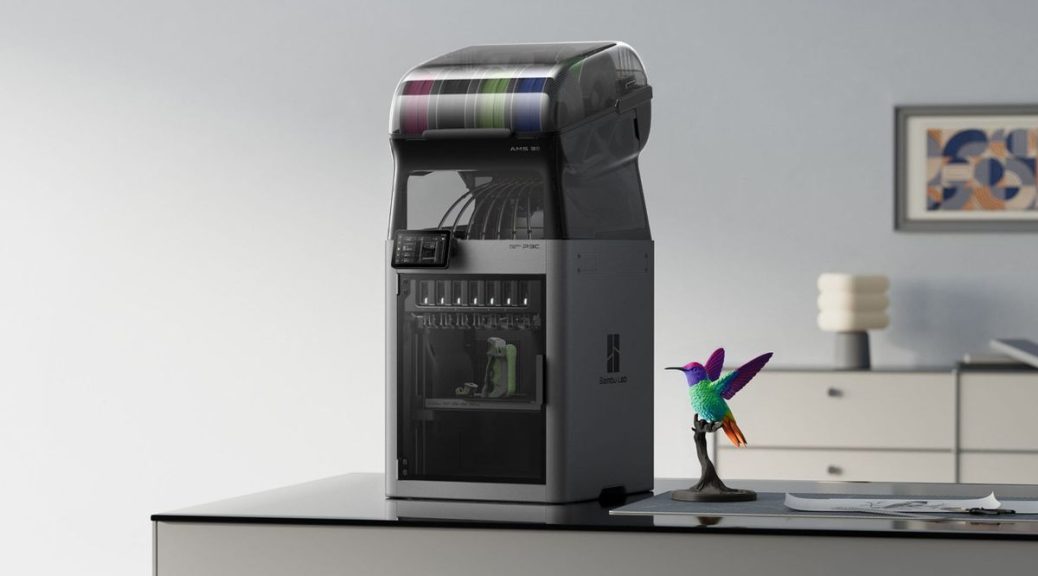
Three weeks ago, Bambu Lab’s H3C made tool-changing 3D printing real — nine independent PrintTools, six-second material swaps, and a $2,499 price that put it firmly in print-farm territory. On Tuesday, November 24, Bambu did the thing everyone was waiting for: it put the same Swaptek architecture in a printer most of us can actually justify. The P3C starts at $1,149, and All3DP’s verdict in its headline says it plainly — this is the Bambu tool changer most people will actually buy.
What you get for $1,149
The P3C is a third-generation, enclosed CoreXY machine built around the same Swaptek system as the H3C, scaled down rather than watered down. Seven slots on the tool rack, five 0.4 mm hardened-steel PrintTools pre-installed, and two open slots for whatever you add later. Each PrintTool carries its own filament path, heater, and power/data connector, so the printer reads ahead, preheats the next nozzle while the current one is still printing, and completes a material change in 6 seconds with minimal purging. Bambu’s own numbers, but the mechanism is the same one reviewers have now had weeks with on the H3C.
The headline specs, straight from Bambu:
- Build volume: 256 × 256 × 260 mm — the familiar Bambu mid-size footprint
- Nozzle: up to 300 °C, hardened steel, in 0.2 / 0.4 / 0.6 / 0.8 mm sizes — and you can mix nozzle sizes in a single print
- Bed: up to 110 °C, textured PEI plate included
- Filament: 1.75 mm and 2.85 mm via the FlexFeed extruder, including TPU down to 75A
- Color mixing: CMYKW — over 180 colors from five base PLA Palette filaments
- Air filtration: H11 HEPA with activated carbon, standard
The FlexFeed extruder is the sleeper feature here. It switches between 1.75 mm and 2.85 mm filament on the fly, and the thicker 2.85 mm path is what lets soft TPU 75A — the squishy stuff most printers won’t touch — print reliably, at up to 3× the flow rate of a classic setup by Bambu’s claim. That means a watch strap in soft TPU, a rigid case, and a finely detailed dial can come off the build plate in a single job, each from the nozzle best suited to it. Bambu’s launch demo is exactly that: a watch printed in one job, dial on a 0.2 mm nozzle, body on 0.4 mm, strap in 2.85 mm TPU.
The catch: the AMS lost its motor
Every cost cut has to land somewhere, and on the P3C it lands in the filament system. The integrated AMS 3P seals seven spools in enclosed, moisture-resistant compartments inside the machine — good for humid workshops — but it has no motor of any sort. You push each filament down to its nozzle by hand, and unloading means pulling roughly half a meter of filament back out. CNC Kitchen’s early testing reckons changing all seven spools takes a good five minutes, and suggests the thing should have been called a Manual Material System.
Tom’s Hardware’s review — the first full hands-on, from Denise Bertacchi — found the same trade-off and still came away positive. She printed a seven-color PLA figure, matte PETG with a PLA support interface, Easy PA, ABS and ASA vise parts, and 48 sets of TPU treads in both 75A (2.85 mm) and 90A, with no failures, and praised the TPU results, the speed of the color changes, and the mixed-nozzle printing. The complaints were practical, not fundamental: the tedious manual loading, the height (you need nearly four feet of vertical clearance to open the AMS lid fully), and tight clearances with sharp plastic edges inside the chamber — one cut her during a tool swap. Her verdict: a good, upgradable starting point for anyone who doesn’t want to pay H3C prices.
Two more trims versus the flagship: no actively heated chamber and a 300 °C nozzle cap (the H3C goes to 350 °C), which rules out PPS and PPA, though CNC Kitchen printed ABS, ASA, nylon, and polycarbonate without trouble. And the optional dryer module — 75 °C, two slots at a time — runs $159.90 and needs its own power adapter. Extra PrintTools are about $99 each.
The map, redrawn again
This is the third redraw of the tool-swap map in five weeks. On October 26, my $849 tool-swap showdown had the Creality K3 and Snapmaker U1 fighting over the affordable tier with the H3C as a specs-TBD wildcard. On November 3, the H3C landed at $2,499 and the map gained a top tier. Now the P3C slots in between: at $1,149 it’s less than half the H3C, only about $300 above the $849 tier, and it parks seven tools against the Prusa XL’s five.
The bundle ladder is worth noting, because Bambu is clearly pricing the on-ramp: the base P3C Combo is $1,149; a seven-tool Multi-Colorist Combo is $1,269 until December 3 ($1,299 after); the Multi-Material Combo with the 2.85 mm TPU tool is $1,299 until December 3 ($1,319 after); and a Complete Experience Combo at $1,699 adds the E1 air purifier and the Bambu Station. UK pricing starts at £999, EU at €1,149. And if seven materials ever stop being enough, four external AMS units can hang off PrintTool 1 for up to 22 colors.
The CraftTools are the other half of the story Bambu is telling: a CutTool and DrawTool mount on the same Swaptek rack, so the same machine can cut vinyl and card or draw with markers. They’re accessories, not in the box, and the 2D work runs in a separate software environment for now — but the platform pitch is clear. This isn’t just a cheaper H3C; it’s Bambu betting that the tool changer becomes the default desktop printer architecture, the way the AMS made multi-color the default three years ago.
Who should buy it
If you print in five or more colors, mix flexible and rigid materials, or you’re tired of purge towers eating a third of your filament, and you tend to leave the same spools loaded for weeks at a time, the P3C is the cheapest way into Bambu’s tool-changer ecosystem — buy the five-tool version and add tools as projects demand them. If you swap filaments constantly, or you need PPS and a heated chamber, the manual AMS and the 300 °C cap will grate, and the H3C (or waiting) is the honest answer. And if you’re still on a single-nozzle machine wondering whether multi-material is worth it at all: the P3C is the first printer that lets you answer that question for $1,149 instead of $2,499.
Where to buy: the P3C is on sale now direct from Bambu Lab — see Bambu’s launch announcement for ordering links and full bundle pricing. It’s store-exclusive at launch — no Amazon listing I could verify today — but you can check Amazon for the P3C here in case Bambu’s official storefront appears there.
As an Amazon Associate I earn from qualifying purchases, which helps cover the cost of keeping this site online.