
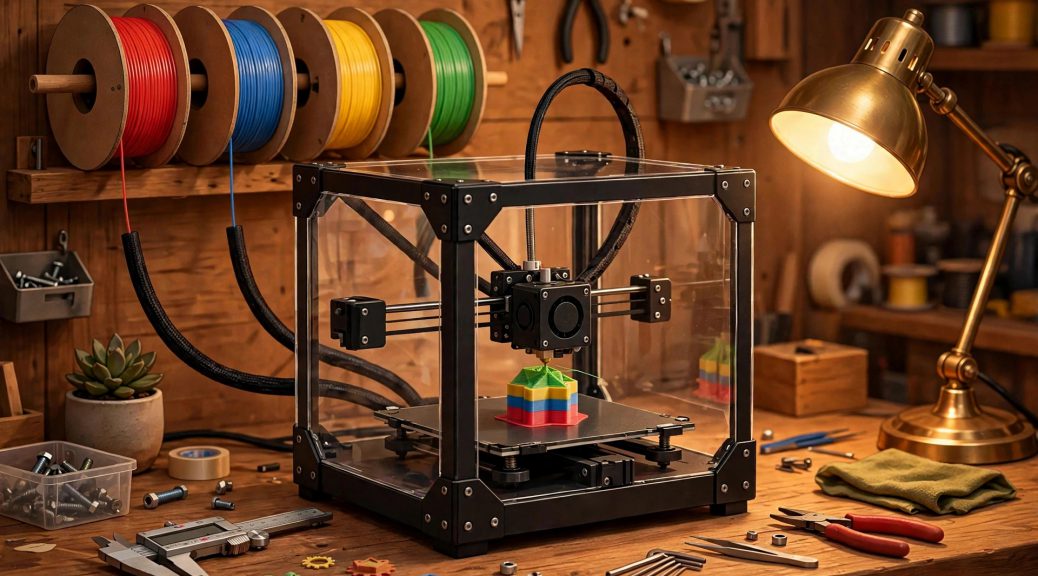
If you’ve ever printed a two-color sign on a single-nozzle printer, you know the dirty secret of multicolor 3D printing: the model might weigh 40 grams, but the purge tower next to it weighs 60. Every color change means flushing mixed filament out of the nozzle — a little pile of plastic “poop” per swap, or a sacrificial tower that exists only to clean the nozzle between colors. It works, but it’s slow and wasteful, and it’s why multicolor prints have always felt like a novelty tax.
This fall, though, the industry’s biggest names are all coming at that problem at once — and each is taking a completely different path. Let me walk through the state of play.
Why multicolor is still hard
Most affordable multicolor printers share one filament path. To switch colors, they retract one filament, load the next, and purge the transition zone until the color runs clean. That purge has to go somewhere: a prime tower, a purge block, or straight out the poop chute. Tool-changing machines dodge the whole problem by giving every color its own hotend — no shared path, nothing to purge — but toolchangers have historically been expensive, fiddly, and slow to swap. The race right now is about making zero-waste multicolor cheap and fast.
Creality’s pen-click approach: SPARKX i8
Creality went the single-nozzle route but attacked the purge itself. The SPARKX i8, launched on Indiegogo on September 21, feeds four independent filament channels into one toolhead via what Creality calls the QuarTeks Color Change System. The shared filament path near the nozzle is under 1 mm long — about 2 mm³ of plastic — which Creality says is at least 30 times shorter than competing designs.
The payoff claims: color channel switches in under a second, zero grams of external purge waste, and no prime tower at all. Creality describes the color change as being like clicking a four-color ballpoint pen. In their own lab tests, a four-color tower requiring 3,000 color switches finished in about 18 hours, which they say is 500% faster than printers using external feed systems.
The caveats are the usual crowdfunding ones: early-bird pricing was $309 against a $399 MSRP, and every performance number above is Creality’s own testing. Still, the engineering idea is sound — shrink the shared path and there’s simply less plastic to flush.
Prusa and Bondtech: the toolchanger goes mainstream
Prusa took the toolchanger path. The Bondtech INDX, developed with Prusa Research and unveiled at Formnext last November, turns a CORE One into a toolchanger with up to eight independent toolheads docked along the front of the machine. Each tool carries its own nozzle and filament — no shared path, no purge at all.
The clever bit is induction heating: the tools themselves contain no wires, no heaters, no thermistors, making each additional toolhead cheap and simple, with the smart toolhead bringing a cold nozzle to temperature in seconds. Tool changes run around 14 seconds, and Prusa cites 20–30 grams of total waste on a large multi-material print versus much higher figures from purge-based systems. The initial 1,000-unit Founders Edition run sold out quickly, and kits are shipping through 2026 in 4-tool and 8-tool configurations.
Bambu Lab: the H3C whispers
Then there’s Bambu Lab, which hasn’t announced anything — and that’s exactly why the rumor mill is spinning. An FCC filing dated September 11, 2026, identifies an “H3C 3D Printer” (FCC ID 2A6J8-PF008P) from Bambu’s legal entity Shenzhen Tuozhu Technology. The same filing spree also turned up a P3C printer, an X2D Pro, two new AMS units, and a handheld S1 3D scanner — the S1 was officially teased on October 12 for a November launch.
Meanwhile, three Chinese patent applications published in August show what looks like a magazine holding up to ten interchangeable printheads. As the rumor trackers at 3D Haber and 3D Bite carefully note, a patent is not a product, and Bambu has confirmed none of this. But read between the lines and it looks like Bambu may be moving toward a tool-changing architecture of its own — a direct answer to Prusa’s INDX. Filed patents plus an FCC grant is about as solid as pre-announcement evidence gets.
Flashforge: full color, no filament at all
And then there’s the wild card. Flashforge’s CJ270, a $3,999 desktop printer using material jetting with UV curing, prints in full CMYK plus white and clear — over 10 million colors, layers down to 7 microns, water-soluble supports. It’s a completely different technology from FDM filament printing, aimed at designers and character-model makers who want photorealistic color straight off the build plate. Shipments are scheduled to begin today, October 15.
At four grand it’s not a hobbyist impulse buy, but it shows where the ceiling is heading: the same way color inkjet printers eventually became desk accessories, full-color 3D printing is starting its own long walk downmarket.
What I’m watching
The interesting thing isn’t any single machine — it’s that four major players independently decided this is the problem worth solving now. Zero-purge toolpaths, induction-heated toolchangers, and full-color material jetting are all attacks on the same enemy: the idea that multicolor printing has to be wasteful and slow.
My practical take: if you’re multicolor-curious, the purge era is ending, but it’s not over yet. Crowdfunding campaigns ship late, toolchangers need tuning, and rumors are just rumors. Still, if your last multicolor print came with a poop chute full of regrets, it’s a good time to be watching this space. I’ll revisit once these machines land in reviewers’ hands and the numbers stop coming from marketing departments.